Alarms (intrinsic reporting)
type: nc (or notification-class) creates a Notification Class object; its instance is the
notification class number. The web UI lists notification classes in the device's object list (read-only:
priorities, ack-required flags and recipients; edit them in the configuration).
| key | meaning |
|---|---|
priority |
[to-offnormal, to-fault, to-normal], default [100, 100, 200] |
ack_required |
3 flags, default [true, true, false] |
recipients |
list of {device: <id> and/or address: "<net>:<mac>" \| "<ip>:<port>", process_id, confirmed, transitions: [3 flags], from_time, to_time, days} |
A recipient given only by device is resolved with Who-Is (another simulated device directly; otherwise
the Who-Is goes out through the router, so the recipient must listen on the simulator's UDP port, usually a
BMS on another host). An address ("<ip>:<port>" means a station on the BACnet/IP side) skips the lookup.
Any value object can carry an alarm block that enables intrinsic reporting:
- type: ai
  name: RoomTemp
  alarm: {notification_class: NC1, high_limit: 30, low_limit: 15, deadband: 0.5, time_delay: 60}
- {type: bi, name: FilterAlarm, alarm: {notification_class: 1, alarm_value: active}}
- {type: msi, name: Status, states: [Stopped, Running, Fault], alarm: {notification_class: 1, fault_values: [Fault]}}
| key | meaning |
|---|---|
notification_class |
name or instance of a notification-class object in the same device |
high_limit, low_limit, deadband, limit_enable |
analog (OUT_OF_RANGE); limit_enable [low, high] defaults to the limits that are set |
alarm_value |
binary (CHANGE_OF_STATE): active / inactive |
alarm_values, fault_values |
multi-state: state numbers or texts; a fault value puts the object in fault |
time_delay, time_delay_normal |
simulated seconds (default 0 / time_delay) |
event_enable |
[to-offnormal, to-fault, to-normal], default all true |
notify_type |
alarm (default) or event |
Event states are evaluated on the simulated clock (time delays follow the speed and stop while paused;
writes are evaluated immediately). Transitions update Event_State, Event_Time_Stamps, Acked_Transitions and
the in-alarm status flag, are sent as Confirmed / UnconfirmedEventNotification to the recipients, and appear
in the event log. The simulator answers AcknowledgeAlarm, GetEventInformation, GetAlarmSummary and
GetEnrollmentSummary (all filters, including the enrollment filter = recipient + process identifier of the
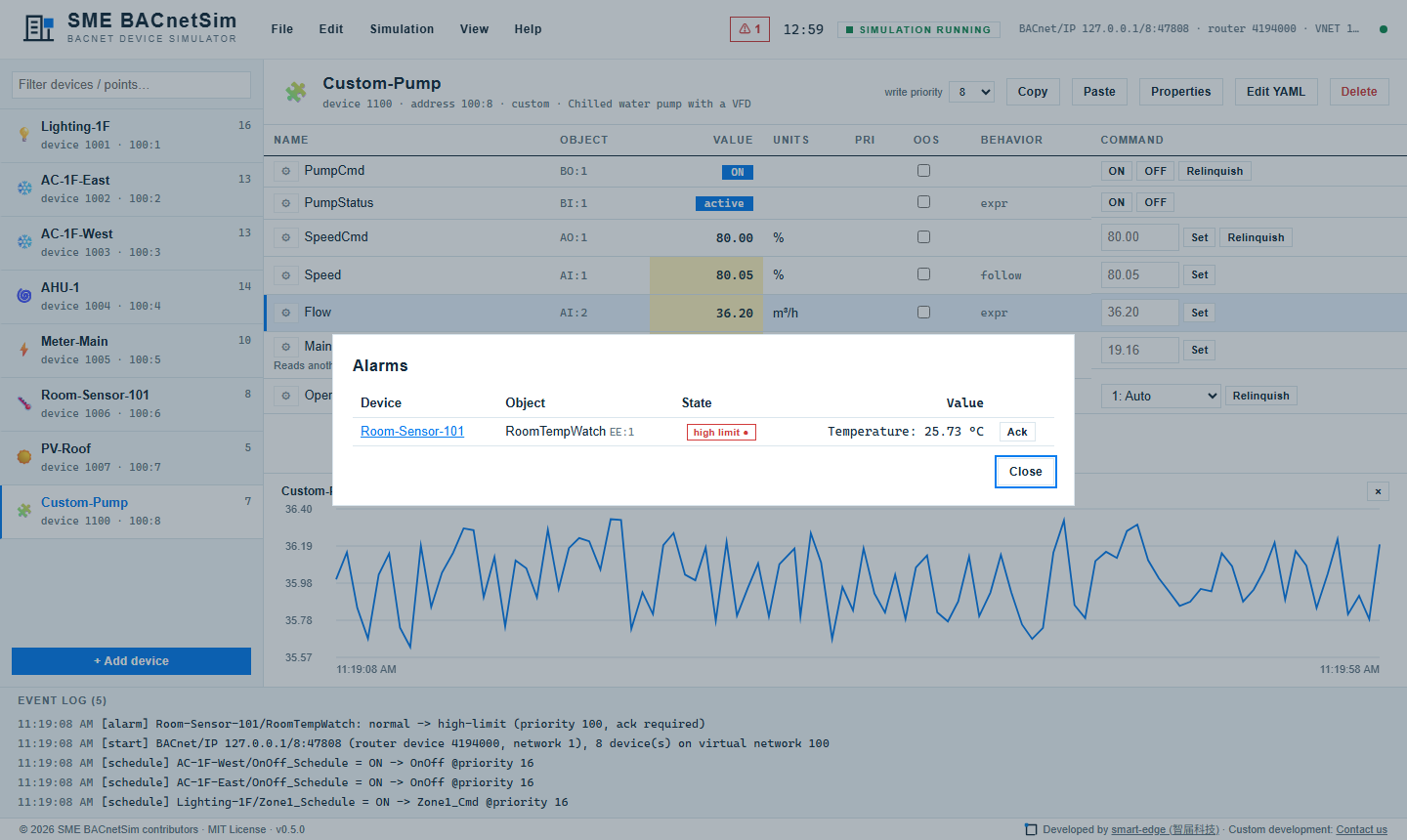
object's notification class); the web UI shows an alarm badge per row, an
Ack button, the active-alarm count in the header and View → Alarms. The split_ac, ahu and
power_meter templates add NC1 (no recipients) and a few alarms; set the template parameter
alarms: false to leave them out. split_ac's RoomTemp high limit (template parameter high_limit,
default 35 °C) is an overheat alarm above the template's ambient peak (33 °C), so the demo starts and runs
without alarms while the ACs follow their schedules; to see one, write high-limit (e.g. 28) from a client.
BACnet writes (WriteProperty / WritePropertyMultiple) to event-enable, limit-enable, high-limit,
low-limit, deadband, time-delay, time-delay-normal, notification-class (must be a notification-class
object of the device) and alarm-value / alarm-values take effect and are written into the config, so
Save / Export keep them. acked-transitions is read-only (WriteProperty answers write-access-denied).
WritePropertyMultiple validates every item first (object exists, property exists, array index, datatype, the alarm property rules above, Priority_Array of commandable objects) and writes nothing if one fails; the error names the first failing object / property. Value checks done only inside an object's own write hook (e.g. trend log / schedule range checks) still run while writing, so such a failure can leave the earlier items of the request applied.
bacpypes3 0.1.0 cannot decode a GetAlarmSummary / GetEnrollmentSummary ACK whose list is empty (a filter
that matches nothing) and reports it as invalid-tag; the simulator itself encodes the empty ACK correctly
and patches the decoder for bacpypes3 clients running in the same process (sme_bacnet_sim/alarm.py).
Other bacpypes3 0.1.0 clients see the same error until they apply the same fix.
A multi-state object that is already offnormal and changes to a different alarm value makes a new
offnormal -> offnormal transition (and notification) after time_delay.
Limitations: bacpypes3's own intrinsic-reporting algorithms run on the wall clock, so the simulator uses its
own (see sme_bacnet_sim/alarm.py).
Not supported: acknowledgment notifications (notify type ack-notification). AcknowledgeAlarm is answered and
updates Acked_Transitions, but no notification is sent to recipients. Exact all-or-nothing semantics of
WritePropertyMultiple beyond the up-front validation above (rollback of already applied writes). SME BACnetSim is free and is built from
public sources only; behaviors that can only be specified from the paid ASHRAE 135 text are left out.