Smart Charging
SME OCPPSim implements the OCPP 1.6 Smart Charging profile: SetChargingProfile, ClearChargingProfile, GetCompositeSchedule, and charging profiles carried by RemoteStartTransaction. OCPP 2.0.1 chargers follow the same model with the 2.0.1 rules, see OCPP 2.0.1 below.
One evaluator for the schedule and the power
The limit that the power model applies every tick is the first period of a one-second composite schedule, computed by the same function that answers GetCompositeSchedule. The schedule reported to the CSMS and the power the simulated EV actually draws (and that appears in MeterValues) therefore cannot diverge.
Each tick: composite limit → min(hardware maximum, limit, EV acceptance) → power (with optional ramp) →
energy register and SoC. A new profile takes effect on the tick right after the CALLRESULT has been sent.
When the limit drops to 0 or below the EV's minimum usable power, the connector goes to SuspendedEVSE; when
the EV is full (target SoC) or tapers below its minimum, it goes to SuspendedEV.
simulation.time_scale speeds up only the power model (ramp, energy, SoC). Profiles are evaluated on the wall
clock, because schedules are in CSMS time: a Relative 60 s period lasts 60 real seconds at any time scale.
Rules implemented from the specification
References are to OCPP 1.6 edition 2 and its errata sheet v4.0.
- 3.13.1: ChargePointMaxProfile only on connectorId 0; TxProfile only on connectorId > 0 and only while a transaction is active on that connector. TxProfiles cease to be valid when their transaction ends (7.10).
- 3.13.2 / 5.16.3 / 5.16.4: a new profile replaces an installed one with the same chargingProfileId, or with the same stackLevel and purpose.
- 3.13.2: per purpose, the prevailing profile is the valid one (validFrom / validTo) with the highest
stackLevel; when its schedule is not running (not started,
durationelapsed) the next lower stackLevel applies (errata 3.43). Without any profile there is no limit. - 3.13.1 / 3.13.3: TxProfile overrules TxDefaultProfile for the current transaction; the result is the minimum of that and ChargePointMaxProfile. A connector-specific TxDefaultProfile replaces the connector-0 one with the same stackLevel for that connector only.
- 7.9 / 7.13: Absolute starts at
startSchedule; Relative, and Absolute withoutstartSchedule, start at the transaction start; Recurring restarts every day / week; adurationlonger than the recurrence is cut to the recurrence (errata 3.43 / 3.44). The first period starts at 0 (errata 3.45); stackLevel ≥ 0 (7.8). - 7.12 / 7.14: W = A × voltage × phases, phases =
numberPhasesor 3 if absent. Errata 3.34: a profile with more phases than the charger has applies its limit to the phases actually available. - 6.13 / errata 3.25–3.26: ClearChargingProfile without fields clears everything; otherwise the given fields
are ANDed; if
idis given all other fields are ignored. Nothing matched →Unknown(7.21). - 5.7: the composite schedule covers [start, start + duration); connectorId 0 reports the whole charger.
- An invalid
chargingRateUnit(like any invalid enum value) is CALLERRORPropertyConstraintViolation(errata 3.24).
Interpretations in this implementation
Where the specification leaves a point open, this implementation decides as follows. The section numbers are the places that were checked.
| Topic | Interpretation | Spec checked |
|---|---|---|
| Relative schedule without a transaction | Relative schedules (and Absolute without startSchedule) on a connector with no transaction use the start of the requested window as origin; ChargePointMaxProfiles always use the window start. The live limit without a transaction is therefore the first period of a Relative schedule |
5.7, 7.13 |
Recurring without startSchedule |
Anchored at 00:00 UTC (Daily) or Monday 00:00 UTC (Weekly). The recurrence also extends before startSchedule, which only fixes the time of day / week |
7.8, 7.9 |
| validFrom / validTo | validFrom inclusive, validTo exclusive | 7.8 |
| connectorId 0 composite | min(ChargePointMax, sum over connectors 1..N of their TxProfile / TxDefault limit). If any connector is unconstrained the sum is unconstrained. Idle connectors count with their TxDefault limit (or make the sum unconstrained), so the value is the most the charger may draw, not what it draws now. A single connector gets the full ChargePointMax value (no sharing between connectors) | 5.7, 3.13.3 |
minChargingRate |
Does not change the limit; refusing to charge below it is the EV model's job | 7.13 |
| "No limit" in GetCompositeSchedule | Unconstrained intervals are reported as the charger's hardware maximum (max_power_w, times the connector count for connectorId 0), so the answer is Accepted even with no profile installed (1.6 has no encoding for "no limit") |
5.7 |
| GetCompositeSchedule answer | scheduleStart = chargingSchedule.startSchedule = time of the request; duration = the requested duration; limits rounded to 1 decimal; adjacent periods equal after rounding are merged. Unknown connector or duration < 1 → Rejected |
5.7, 7.13 |
| Fractional period boundaries | A boundary between whole seconds starts at the next whole second (startPeriod is an integer) |
7.13 |
| Unit when none given | W | 7.13 |
| Limit in A and phases | Applies to the phases the EV uses while one charges, and to the supply's phases otherwise | errata 3.34 |
| Replacement scope | Same stackLevel + purpose replacement is per connectorId (a connector-specific TxDefaultProfile replaces the connector-0 one "only for that specific connector") | 3.13.1 |
| TxProfile for another transaction | A TxProfile whose transactionId differs from the connector's active transaction is Rejected |
3.13.1 |
| Malformed profiles | Recurring without recurrencyKind, non-increasing startPeriod, an empty period list, a connectorId outside 0..N, or validTo ≤ validFrom → Rejected |
7.13 |
| Value ranges the schemas do not carry | Negative limit / startPeriod / minChargingRate, numberPhases outside 1..3 and duration ≤ 0 → Rejected |
7.13, 7.14 |
| RemoteStartTransaction profile | Must be a TxProfile without transactionId ("SHALL NOT be set"); otherwise Rejected without starting a transaction. It is installed, bound to the new transactionId, once StartTransaction is answered |
5.16.2, 6.33 |
| Connector out of range | SetChargingProfile / ClearChargingProfile with a connectorId outside 0..N → CALLERROR PropertyConstraintViolation, like other connector-addressed requests |
— |
| Offline gap | Ticks run only while connected; after an offline gap the first step integrates the gap at the limit in force on reconnect | — |
Power model conventions
These are simulator conventions, not OCPP rules:
- Electrical power is
V_phase × I × phases. Withline_to_line: trueon a 3-phase supply the per-phase voltage isvoltage_v / √3, so P = √3 × V_LL × I. Phases in use = min(EV phases, supply phases). - Energy is integrated with the trapezoid rule; the energy register only grows. SoC may overshoot the target by at most one step.
- Ramps (
ramp_up_w_per_s,ramp_down_w_per_s) are in W per simulated second; the default is a step change.
OCPP 2.0.1
A 2.0.1 charger has its own copy of these rules (protocol/v201/profiles.py / composite.py); the power model
is shared, so the same closed loop holds: GetCompositeSchedule equals the Power.Active.Import of the following
TransactionEvent readings. Messages: SetChargingProfile, ClearChargingProfile, GetCompositeSchedule,
GetChargingProfiles (answered by ReportChargingProfiles parts, one per EVSE and chargingLimitSource, tbc on
all but the last), NotifyChargingLimit and ClearedChargingLimit, and the chargingProfile of
RequestStartTransaction (installed bound to the transaction it starts).
| Topic | Behaviour (interpretation where the schemas are silent) |
|---|---|
| Purposes | ChargingStationMaxProfile (evseId 0 only, never Relative: K01.FR.38), TxDefaultProfile, TxProfile (evseId > 0, needs the transactionId of the EVSE's running transaction: else TxNotFound, K01.FR.09), ChargingStationExternalConstraints (never from the CSMS: Rejected with UnsupportedPurpose, errata K01.FR.62) |
| Limit of an EVSE | min(ChargingStationMax, external constraints of evseId 0 and of the EVSE, TxProfile else TxDefaultProfile) |
| evseId 0 | min(ChargingStationMax, external constraints of evseId 0, sum of the EVSE limits); unconstrained if one EVSE is |
| Stack level conflict | another profile with the same EVSE, purpose and stackLevel and an overlapping validity period (K01.FR.06), a TxProfile with the same stackLevel and transactionId whatever its validity (K01.FR.39), or a TxDefaultProfile with the stackLevel of one on evseId 0 / on an EVSE (K01.FR.52 / FR.53) is Rejected with DuplicateProfile (a same-id profile replaces) |
chargingSchedule array |
exactly one schedule; more are Rejected (K01.FR.34: only with ISO 15118, which is not simulated). startSchedule is required for Absolute / Recurring and forbidden for Relative (K01.FR.40 / FR.41) |
| ClearChargingProfile | chargingProfileId wins over the criteria; the criteria are ANDed; external constraints are never cleared by the CSMS |
| Device Model | SmartChargingCtrlr ProfileStackLevel (100), PeriodsPerSchedule (1024) and RateUnit (A,W; another unit: UnsupportedRateUnit, also for GetCompositeSchedule, K08.FR.07) are enforced; ExternalControlSignalsEnabled false refuses the external limit; NotifyChargingLimitWithSchedules decides whether NotifyChargingLimit carries the schedule |
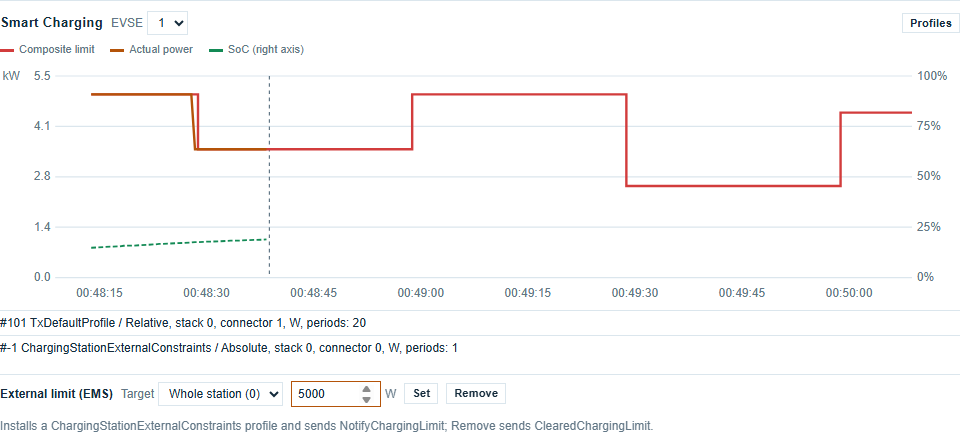
External limit. POST /api/chargers/{id}/external-limit stands in for an energy management system: it
installs a ChargingStationExternalConstraints profile (stackLevel 0, one period in W, negative profile id) on the
EVSE or the station and sends NotifyChargingLimit (chargingLimitSource EMS); removing it sends
ClearedChargingLimit. Both are sent only while the boot is accepted (a limit set offline applies but is not
reported later). GetChargingProfiles reports these profiles with source EMS, the CSMS ones with CSO.
While a transaction runs, a change of the external limit that changes the rate the EVSE may charge at also
queues a TransactionEvent Updated with ChargingRateChanged (K11.FR.04 / K13.FR.03).
OCPP 1.6 has no external limits and answers 400.
In the web UI the Smart Charging panel of a 2.0.1 charger has an External limit (EMS) row: pick the whole station (0) or an EVSE, enter a limit in W and press Set, or press Remove. The external constraints profile then appears in the profile list, and the composite limit in the chart includes it.
The 2.0.1 rules are checked against OCPP 2.0.1 Edition 4 (Part 2 K01 / K08 / K10 / K11 / K13, errata
2026-09); the requirement ids are in the docstrings of protocol/v201/profiles.py and composite.py.