HTTP API
The web UI uses this API; you can script against it too. All routes are served on the UI port (default 8081).
| Method | Path | Description |
|---|---|---|
| GET | /api/state |
Snapshot of simulation, listeners, devices and point values |
| GET | /api/templates |
Available device templates and their parameters |
| GET | /api/history/{device}/{point} |
Recent samples of a point |
| POST | /api/devices/{device}/points/{point}/write |
Write a point, body {"value": 12.5} |
| POST | /api/simulation |
Pause / resume and set the time scale: {"running": true, "time_scale": 10} |
| GET | /api/config |
The current configuration as YAML |
| PUT | /api/config |
Replace the configuration (YAML body); invalid files are rejected with the reason |
| POST | /api/config/save |
Write the current configuration back to the config file |
| GET | /api/trace |
Recent Modbus requests / responses; query limit, unit, fc, listener |
| GET | /api/stats |
Request counters |
| GET | /api/version |
Simulator version |
| WS | /ws |
Live stream of value changes, trace entries and events |
curl -X POST http://127.0.0.1:8081/api/devices/PCS-1/points/p_setpoint/write \
     -H "Content-Type: application/json" -d '{"value": 20}'
Excel and user templates
| Method | Path | Description |
|---|---|---|
GET |
/api/config/xlsx |
Running configuration as .xlsx |
GET |
/api/config/xlsx-template |
Blank workbook |
POST |
/api/config/import |
Import a workbook (multipart file); 400 with an error list |
POST |
/api/templates/reload |
Reload the user template directory; returns loaded and per-file errors |
POST |
/api/templates/from-device/{device} |
Save a device's expanded points as a user template ({"name", "overwrite"}); 409 if it exists |
Fault injection
| Method | Path | Description |
|---|---|---|
GET |
/api/faults |
Rule list {"rules": [...]} (with triggers, matches, active) |
POST |
/api/faults |
Create a rule (JSON); returns it with its id |
PUT |
/api/faults/{id} |
Update a rule; omitted fields keep their value |
DELETE |
/api/faults/{id} |
Delete a rule |
POST |
/api/faults/clear |
Delete all rules |
POST |
/api/faults/preset |
Load a YAML / JSON preset (body); replaces all rules, ?replace=false appends |
GET |
/api/faults/export |
Rules as faults.json |
Changes are pushed on /ws as {"type": "faults", "rules": [...]}. See Fault injection.
Device management
| Method | Path | Description |
|---|---|---|
POST |
/api/devices |
Add a device (JSON: name, unit_id, optional listeners, template, params, points, ...) |
POST |
/api/devices/{name}/duplicate |
Copy a device; optional JSON {"name", "unit_id"}, defaults {name}_copy and the next free unit id on the same listeners |
DELETE |
/api/devices/{name} |
Delete a device |
GET |
/api/devices/{name}/config |
That device's configuration as YAML |
PUT |
/api/devices/{name}/config |
Replace that device with the YAML body (a rename is allowed) |
Every change is validated and applied with the same reload as PUT /api/config; the running configuration is
re-written from the model (only the keys that were set are kept, YAML comments are lost) and
POST /api/config/save writes it to the file. Errors: 404 unknown device, 409 name already used,
400 validation error (the message lists each pydantic error as field: message). See Device management.
Statistics push
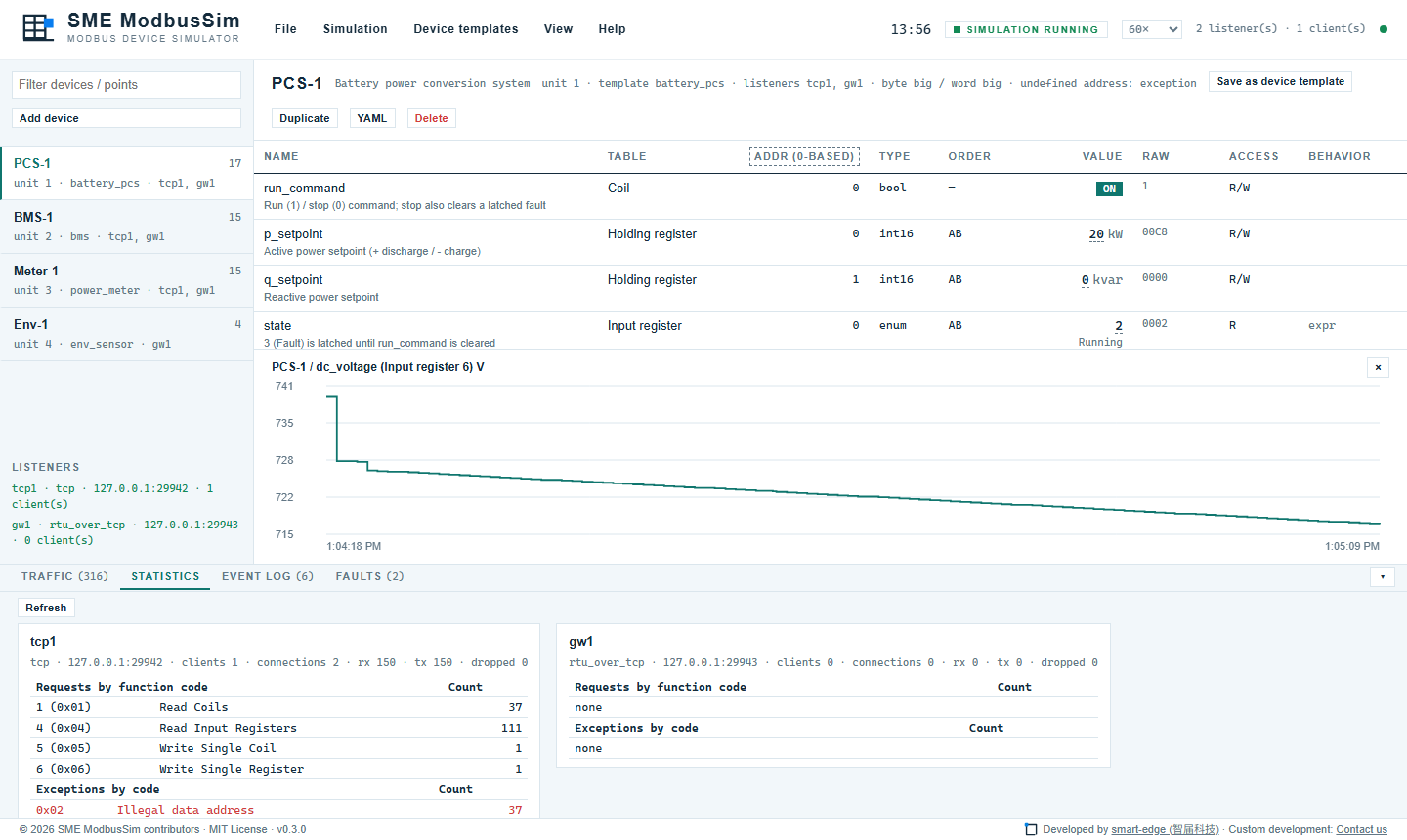
While at least one client is connected, /ws pushes the per-listener counters every 2 s:
{"type": "stats", "t": 1764052800.0, "stats": {"tcp1": {"type": "tcp", "requests": {"3": 120}, "exceptions": {}, "clients": 1}}}
stats has the same shape as GET /api/stats.